A Walk with One Small Thing to Notice
A walk with one small thing to notice turns a familiar route into a calmer outing: choose a changing detail and follow it at your own pace.
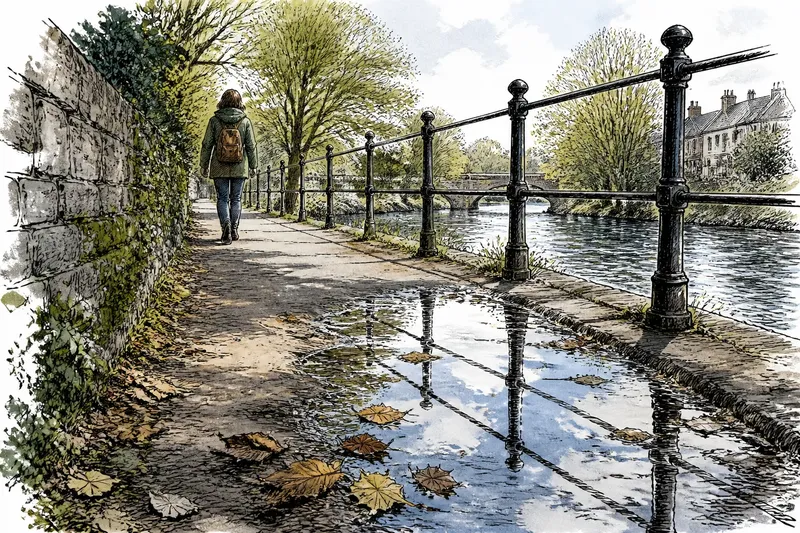
What can you notice on a walk you already know by heart? Choose one small detail that is changing—a puddle shrinking, leaves turning, or the direction of grass in the wind—and let it guide your attention along the route. A walk with one small thing to notice needs no special kit or new destination; the point is to see how that detail shifts as you move.
What should I choose to notice on a familiar walk?
Choose something visible, ordinary and likely to vary as the walk unfolds. The best subject is not necessarily rare. A patch of moss on a wall, a line of fallen leaves beside the kerb, or clouds moving above the rooftops can hold your attention without asking you to leave the path or interrupt the walk.
Make the choice specific enough to recognise again. “Nature” is too broad; “the way rain gathers along the edge of the footpath” gives your eyes a clear place to return to. You can focus on a single object, such as a tree, or a repeating feature, such as shadows crossing the pavement. Either approach works as long as it invites observation rather than a hunt for a perfect sighting.
Let the conditions suggest a subject, rather than trying to force one. After rain, look at water moving through a gutter or marks drying on a bench. On a breezy day, watch seed heads or a flag respond to gusts. In bright weather, follow the edges of shade as they fall across a familiar stretch of ground. If nothing catches your interest, choose something nearby and give it a few moments before deciding whether to switch.
How do I follow a changing detail without making a checklist?
Return to the detail at natural pauses in the walk, then notice what has changed since you last looked. You might see it near a gate, again where the path bends, and once more at the turn towards home. There is no need to record each appearance, collect a set of observations or make sure you have covered the whole route.
Think of attention like a bookmark: it helps you return to a place in the experience, but it does not turn the whole book into a list. Look, walk on, and look again when it feels natural. If your subject disappears from view, stay with the idea rather than searching urgently. A changing detail can become less visible, move elsewhere or simply stop holding your interest.
Keep your pace comfortable and your route familiar. You do not need to slow to a stop every time you notice something; a glance may be enough. If you want to examine a small feature more closely, pause somewhere that leaves room for other path users. The walk remains a walk, not an exercise in gathering material.
Which changing details work in different weather?
Look for changes that the day makes easy to see. Weather is useful because it alters familiar surroundings, but it need not dictate a long outing or special preparation. Choose a subject visible from a suitable path and let it be enough if the conditions change before you do.
- After rain: Notice where puddles form, how their edges change, or which leaves remain wet beneath a tree.
- In wind: Follow the movement of long grass, branches or seed heads from a sheltered viewpoint.
- In bright sun: Watch a patch of shade cross a wall, path or open piece of ground.
- On a cool morning: Look for mist lifting from a field or moisture fading from a railing.
- During a seasonal shift: Notice one tree’s colour, bare branches or fresh buds rather than trying to survey every plant.
These are invitations, not conditions to wait for. If your chosen detail is hard to see, pick a nearby one that suits the day. The useful part is not finding the most dramatic change; it is noticing a small difference without needing to turn it into a result.
What should I do if the detail disappears or the walk feels dull?
Let the subject change or let your attention move on. A cloud may cover the sun, a puddle may be gone, or the path may not offer the view you expected. You can notice that absence, choose another detail, or carry on without replacing it. None of those choices means the walk has gone wrong.
Say you set out on a familiar riverside path intending to watch leaves caught near the bank. The water is high and the leaves are moving too quickly to follow comfortably. You turn your attention instead to the reflections between the path’s railings, noticing how they break up as you pass. The outing continues at an easy pace, without detouring to find a better view or trying to account for every change.
If the walk starts to feel like a task, loosen the prompt. Look up from the chosen detail and take in the route around you. You may discover that you would rather talk with a companion, listen to the birds, or simply walk quietly. A prompt is there to offer a point of interest, not to compete with the rest of the outing.
How can I notice carefully without disturbing wildlife or other walkers?
Observe from the path and give animals room to move away. Do not approach nests, dens or feeding wildlife to improve your view, and avoid touching plants, fungi or objects you cannot identify. If a detail is out of reach, too fragile or drawing you towards an unsafe place, choose something else in plain view.
On a shared path, keep your attention broad enough to notice people, bicycles and dogs approaching. Step aside where the path allows, and avoid stopping across a narrow section. If you are walking with someone, agree on a prompt they can enjoy too, but do not expect them to share your interest or follow your pace exactly.
For an unfamiliar route, consider the surface, weather and daylight before heading out, and follow local access signs. Keep your phone available for ordinary navigation or emergencies rather than treating it as a required observation tool. The prompt should fit the walk you can comfortably make, not persuade you to take a risk for a closer look.
Do I need to take photographs or keep notes?
No. Looking is enough, and leaving your phone in your pocket can make it easier to stay with the walk. A photograph or a brief note can suit you if you enjoy keeping a record, but neither is needed to make the outing worthwhile.
If you choose to take a picture, do so from a safe place without stepping into planted areas or blocking the route. A quick note afterwards can capture what changed: perhaps the same branch looked different in wind than it did in still air. Keep the record brief if detail begins to matter more than being outside.
You can also let the observation end when the walk does. The point is not to build a collection of images or prove that you paid attention. Sometimes the most satisfying result is simply recognising a familiar corner in a new way and then carrying on with your day.
How do I choose a prompt for my next walk?
Start with the route and conditions you already have, then pick one detail that can be noticed without changing your plans. The next time you take that walk, the subject may be entirely different. If you want to repeat the same prompt, you can; familiar details often reveal another change when you return.
A walk with one small thing to notice works best as an invitation you can set down at any point. Choose a subject, return to it when convenient, and let the route decide how long it remains interesting. Before heading home, take one last look if you like. Then leave the detail where it is and enjoy the ordinary walk back.