Borrowing, Sharing or Owning the Kit for a New Hobby
Borrowing, sharing or owning hobby kit: choose an option that fits your access, commitment and space before buying equipment for a new interest.
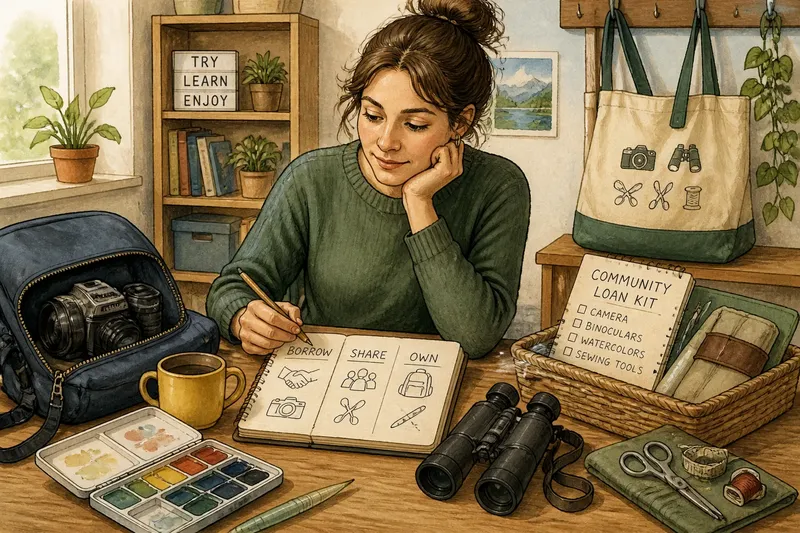
Borrowing, sharing or owning hobby kit can change how easy it is to try a new interest. If you are eyeing a camera, a set of watercolours or a pair of binoculars, the useful question is not simply which option costs less: it is which one lets you take part when you want to.
Think of equipment like a library book, a shared kitchen tool or a notebook you keep beside your chair. Each arrangement gives you a different balance of access, responsibility and convenience. Use these seven checks to decide whether to borrow, share or buy.
1. Borrow first when you are still learning what the activity involves
Borrowing is a good way to discover whether the object suits the activity you have in mind. A beginner may picture using a full-size easel, only to find that small watercolour studies at the kitchen table are more appealing. Borrowing lets you try the actual work before committing to a particular style of equipment.
Start with people and services that make borrowing straightforward: a friend who can explain the basics, a local library of things, a community workshop or a hobby group with loan equipment. Ask what is included. A camera body without a suitable lens, for instance, may not let you try the kind of photography you are considering.
Agree on a return date, the condition the item should come back in, and what to do if something gets damaged. Check the maker’s instructions and any relevant local rules when they apply. This is especially sensible for equipment with handling requirements or items shared by a group.
Borrowing is less useful when access is unpredictable. If you must arrange collection each time, return the item before an event, or wait for a popular piece of kit, the friction may stop you taking part. Treat those arrangements as part of the decision, not as a minor detail.
2. Share when the activity has a natural group rhythm
Sharing works well when people use the same equipment at the same place or can plan sessions together. A sewing circle might keep a cutting mat and fabric shears in its meeting room. A birdwatching group could lend a spare pair of binoculars during outings. The equipment is available where the activity happens, without each person needing to store a duplicate at home.
Before joining in, find out how the group manages access. Is there a booking calendar, a named person responsible for the kit, or a clear way to report missing parts? Good arrangements make shared gear feel available rather than vaguely communal. If no one knows who has the item, the group may spend more time tracking it down than using it.
Consider whether your schedule fits the group’s. Sharing may be a poor match if you want to practise alone at short notice or take equipment away for a long session. In that case, a loan from a service with predictable terms or a modest personal item may suit you better.
3. Borrow, share or own based on when access matters
Ask when you are most likely to use the equipment. If your interest centres on a regular club meeting, shared kit may be enough. If you want to practise in brief, spontaneous bursts at home, having the object nearby can matter more than owning the most capable version.
Imagine you are curious about sketching on a weekly train journey. A friend lends you a compact set of pencils and a pad for a few trips, and you notice that you draw most when the tools fit in your coat pocket. The observable result is a clearer preference: if the same small kit would be ready for future journeys, ownership may add convenience; a large drawing set would not answer the need you discovered.
Do not confuse wanting access with wanting possession. A borrowing arrangement can provide reliable access without putting another object in your cupboard. Conversely, if collecting and arranging tools is part of the enjoyment, that preference is relevant too. Choose for the way you actually want to engage, rather than for an imagined version of the hobby.
4. Own only the parts that make participation easier
Personal ownership adds value when it removes a recurring obstacle or lets you tailor the experience. A musician may appreciate a personal mouthpiece for comfort, while a casual visitor to a pottery studio may need only the tools supplied there. A walker who uses a familiar, well-fitting day bag might reasonably keep that one item, even if they borrow specialist equipment for occasional trips.
Separate essential items from upgrades. Ask what the activity requires to begin, what can be supplied by a venue, and what would merely offer more options. A beginner in calligraphy might need paper and a basic pen to practise lettering; an extensive collection of nibs and inks can wait until there is a clear reason to use them.
Ownership also brings care and storage. Decide where the equipment will live, how you will keep its parts together and whether cleaning it after use feels manageable. A set that is difficult to find or prepare may become a barrier, even if it is technically yours and ready to use.
5. Compare the full commitment, not just the purchase
Buying equipment is one kind of commitment; borrowing and sharing have their own obligations. A borrowed item may need prompt returns and careful handling. Shared equipment may require booking, cleaning or contributing to upkeep. Owning means accepting storage, maintenance and the decision about what to do if your interest changes.
Write down the practical costs in ordinary terms: time spent collecting, access you may have to schedule, space occupied at home and effort needed after a session. These details often reveal more than an abstract question about whether a purchase is “worth it”. For example, a large instrument might be available to try at a music centre, while a compact practice instrument could be easier to keep beside a desk.
Where an item is costly or hard to resell, avoid treating the purchase as proof of commitment. You can be genuinely interested and still prefer to borrow until you understand what features matter. Enthusiasm is a reason to explore; it does not require buying the whole setup at once.
6. Look for a middle ground between borrowed and personal
You do not have to choose one arrangement for every part of a hobby. A person learning printmaking might use a community studio’s press, buy a personal sketchbook and borrow specialist tools for a particular project. This mix keeps the items used often close at hand while leaving occasional or bulky equipment with the people who can share it.
Try a small personal purchase only after you can name its job. Useful reasons include a size that travels easily, a fit that makes the activity more comfortable, or a familiar setup that saves repeated borrowing arrangements. “I might need it eventually” is less specific and rarely helps you choose between models or decide where the item belongs.
Check the boundaries of each arrangement before relying on it. Ask a group whether equipment can leave its premises, and ask a lending service whether accessories are included. Those answers shape what you can actually do with the kit.
7. Reassess ownership when your needs become clear
After trying an activity, note what you reached for, what you avoided and what interrupted a session. Perhaps a borrowed telescope was enjoyable at a stargazing event, but carrying it to a remote spot proved inconvenient. Perhaps you repeatedly wanted a small notebook while leaving a larger art set untouched. These observations point towards the right kind of access rather than a vague urge to acquire more.
When you do decide to buy, choose around the use you have identified. Read product descriptions carefully, check compatibility with equipment you already use and look for guidance from a reputable shop, club or instructor. If the choice depends on a specialist fitting or a technical requirement, ask someone qualified in that activity.
Borrowing, sharing or owning hobby kit is not a test of seriousness. It is a practical choice about access, effort and the role an object plays in your leisure time. Begin with the arrangement that makes it easiest to take part, then let your actual needs—not an imagined perfect setup—show where personal ownership adds value.